












Juanita McNeely
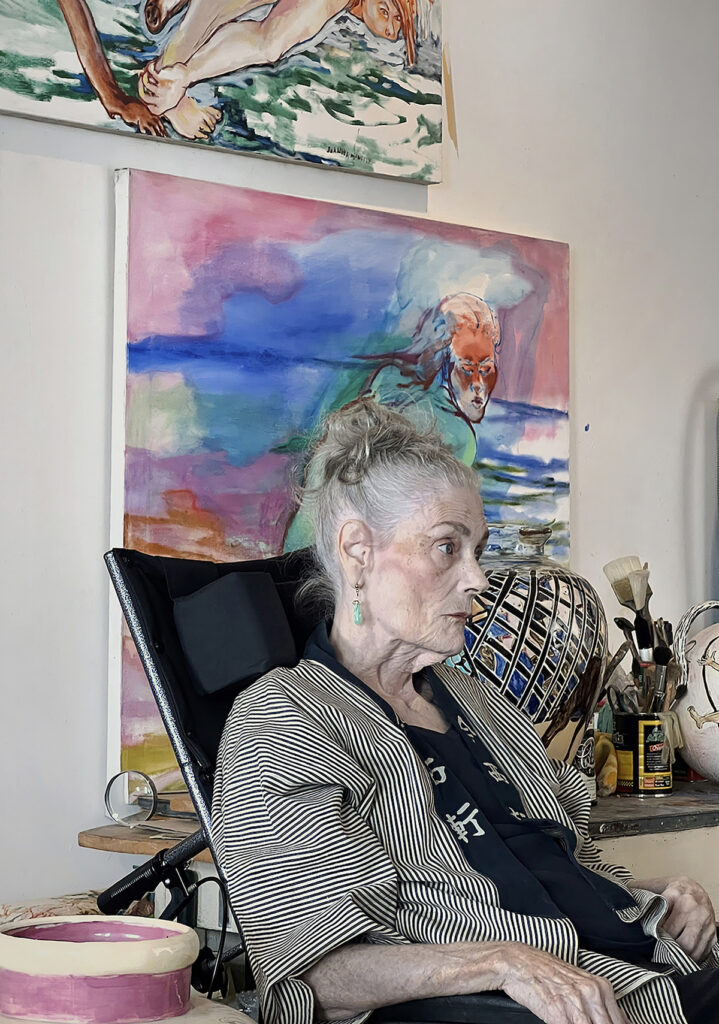
Throughout her six-decade career, Juanita McNeely (1936–2023) conveyed the extreme physicality and movement of the human figure, informed by her close observation of others as well as her personal experiences of sexism, abortion, illness, and disability. Over time, McNeely developed a powerful visual vocabulary that focused on the human condition depicted in radiant color ranges filled with lightness and shadow—driven by what she described as the need to “make the ugly and the terrible beautiful for myself.” Her figurative work brazenly defied the conventions of art history, approaching the human form as a source of power, emotion, movement, and rupture. McNeely’s figures are often contorted, suspended in mid-air, and directly interfacing with the picture frame itself, unconstrained by gravity and resisting confinement. Born in St. Louis, Missouri, McNeely moved to New York City in 1967, where she was an integral member of the Fight Censorship group founded in 1973 by Anita Steckel, alongside peers including Louise Bourgeois, Joan Semmel, Hannah Wilke, Judith Bernstein, Martha Edelheit, and Eunice Golden; as well as Women Artists in Revolution (W.A.R.), Redstockings, and other artist activist groups. Her work is in the permanent collections of the the Whitney Museum of American Art, New York; Minneapolis Institute of Art; Rubell Museums, Miami and Washington DC; Palacio de las Bellas Artes, Mexico City; and National Museum of History & Art, Taipei, among others.